For
George, and my Family;

In Honor and Recognition

George Beeton
A partial history of
Private George Beeton's Military Service
A time line by; Donald George Beeton
Thanks to the information provided to me by my very dear mother Joan,
I was able to finally make some real progress in my efforts to try to
gain an understanding as to what my Grandfather, my dad William
Donald's father,
George Beeton did in the Great War. I have been able to find out about where George served and fought for Canada, some of the roads he traveled, who his comrades in arms were and also I've been able to learn about some of the extremely difficult and dangerous trials they faced and went through together.
Thank
you Mom.
It's my hope that the efforts and dedication and the sacrifices George Beeton and his fellow soldiers made and suffered through together are remembered, recognized and appreciated.
I've
had access to George's personal Service records online and I first saw
his records in December 1998 after requesting a copy from the
government but I was always confused by the number of different
battalions that he was
taken onto over the course of the war and as a result I didn't know the name of the primary unit
where he served with 100% certainty. The Canadian
Great War Project
records that his unit was the 148th Battalion and his service in the
Canadian Infantry did begin with the 148th but I knew that at some
point he had to have been transferred out of the 148th because the
148th was not directly involved in the Vimy campaign and George did
serve in the Battle of Vimy Ridge.
Recently I started asking mom questions about George and Emma and their old house in Greenfield Park in Montreal and various related things. Then one day while I was visiting mom surprised me when she gave me a small box containing George's medals, ribbons, battalion cap badge and various other brass badges, buttons and pins etc. I hadn't seen George's medals before and that's when I discovered that the soldier's Regimental number, name and unit is engraved around the outside edges of both the British War Medal and the Victory Medal.
841969 PTE G. BEETON 24th BN CAN INF
Now with George's main unit finally confirmed I have been able to make progress. This was the most important point in time for me in my efforts to understand George's service.
Then shortly after that I had some more really good luck while doing an internet search when I found the PDF version of a hard cover book that was published by the 24th Battalion in 1930, "The 24th Battalion, C.E.F., Victoria Rifles of Canada, 1914-1919." It seems to me that this publication serves as essentially a type of unofficial war diary for the 24th Battalion. Now finally the picture and the story of George's service has come into focus for the first time.
I want to thank author editor R.C. Fetherstone and the members of the 24th Battalion Victoria Rifles of Canada who told their story when they published;
"The 24th
Battalion,
C.E.F., Victoria Rifles of Canada, 1914-1919."

The vast amount of relevant information available is new to me. I knew the basics about World War One and I've always had a general interest in the history of the two world wars however I am not any sort of expert on these subjects.
I had no information about my grandfather's service other than for the fact that we as a family always knew that he fought in The Battle of Vimy Ridge. I decided that as I read through the pdf version of their hard cover book, "The 24th Battalion, C.E.F., Victoria Rifles of Canada, 1914-1919." (the unofficial war diary of the 24th Bn, is what I'll call it,) while cross referencing George Beeton's personal service records, I would record some of the information in the form of a time line here for everyone in our family, and of course for George.
I include quotes and some background information in an attempt to develop a time line that also provides some information about a typical Canadian infantryman's routine and everyday life in the field along with information about some of the specific military actions that George participated in while he was serving in the field with the 24th Victoria Rifles.
This has been a time of discovery for me as I learn about George's military service in far greater detail than I ever thought I would. Although I was as careful as possible compiling the below time line it may contain some factual errors and there will definitely be format and grammar errors that I hope won't detract from the meaningful facts in any sort of significant way. The supporting documents and records that are included provide an opportunity for clarification and further understanding.
In the unofficial war diary of the 24th Canadian Battalion there is a vast amount of detailed information available far too much to include below on this page. As a result the below time line contains many gaps in time and is unavoidably incomplete. Reading the unofficial war diary of the 24th Bn will allow you to see and understand the time line in a much more complete and detailed way. I link to the 24th Battalion's unofficial war diary below at the point were it fits into the time line.
As I read through the unofficial war diary of the 24th Battalion trying to sort through the information deciding what information I was going to quote I was always discovering more about George's experiences and the things and events that actually happened and the incredible situations he was in and the impressive story of Montreal's 24th Battalion VRC along with the other three battalions of the 5th Canadian Infantry Brigade, the 22nd Canadien Francais Battalion, the 25th Nova Scotia, and the 26th New Brunswick Battalion. I highly recommend reading this document that includes a stunning amount of very detailed interesting information.
This was a surprise for me but it's not unreasonable to suggest that a type of disclaimer warning or heads up for the reader that included in the unofficial war diary of the 24th Battalion there are some very graphic descriptions of some of the casualties and deaths. This is a guess, I think the surviving members of the 24th who were involved in compiling the information for their unofficial war diary may have included this level of graphic information because they wanted people to know how terrible the war actually was and how the members of the 24th suffered while bravely facing those dangers for each other and ultimately for all of us.
I will be making corrections updating this page over time as it has become a work in progress. If you happen to discover more information or any corrections that I need to make or you have links you would like included or you have suggestions etc, I would be very happy to include that information,
thank you.
George Beeton
Born April 3rd, 1893 in London, England.
We still don't know what George's middle name was in fact Dad said he didn't actually know if George had a middle name. We are guessing that he probably did have one but unfortunately we have no record of it as far as I am aware.
Page (3 and 12 of 77) George Beeton's Service Records
Next of kin;
Mr.
Daniel
Beeton: Father
34 St., Cecil Street, Montreal,
P.Q.
I don't think George would recognize his father's old neighborhood today.
34 Cecil Street today. Google Maps street view.I don't think George would recognize his father's old neighborhood today.
Page (12 and 26 of 77)
Mrs.
Eliza Beeton:
Mother
2, Carlisle Road
Upper Tollington Park,
Stroud Green, London N
#2 is the house built with the light coloured blocks. Google Maps street view.
#2 is the house built with the light coloured blocks. Google Maps street view.
August 4th, 1914
Britain declares war against Germany.
August
6th, 1914
The 17th Duke of York's Royal Canadian Hussars, "Argenteuil Rangers,"
the Canadian Cavalry Regiment, is placed on active service for local protection duties, Montreal, Quebec.
Page (3 of 77) George Beeton's Service Records
George Beeton served two years with the 17th Duke of York's Royal Canadian Hussars, Argenteuil Rangers. He then enlisted in the Canadian Infantry April 3rd, 1916. This April 3rd, 1916 enlistment date should place George's enlistment in the Argenteuil Rangers on or before April 3rd, 1914.
"Originally, Hussars were light cavalry mounted on fast horses. They were used to fight skirmish battles and for reconnoitring."
"By 1914 cavalry duties consisted largely of reconnaissance and protection. Hussars, lancers and other mounted units were used to form a screen ahead of the advancing infantry and artillery. They made first contact with the enemy, then discovered and reported his dispositions and movements.
Today's hussar regiments drive armoured vehicles.

"The Royal Canadian Hussars, (Montreal) trace a direct history to the Montreal Volunteer Cavalry formed in the late eighteenth century. The amalgamation of two famous Montreal regiments of cavalry the 6th Duke of Connaught’s Royal Canadian Hussars and the 17th Duke of York’s Royal Canadian Hussars became effective September 15, 1958. The amalgamated regiment of the Royal Canadian Armoured Corps was designated the “Royal Canadian Hussars (Montreal)” and is one of the two oldest units of Volunteer Cavalry in Canada." Some History
"The present Regiment is an armoured reconnaissance regiment in the Reserve Force that consists of five cavalry and one armoured formation: the Royal Montreal Cavalry, the 5th Dragoons, the 6th Duke of Connaught’s Royal Canadian Hussars, the 11th Argenteuil Rangers, the 17th duke of York’s Royal Canadian Hussars and the 1st Motor Machine Gun Brigade." Regimental History
In September 2021 I made an enquiry with the Royal Canadian Hussars Association regarding George Beeton's service. I was very happy to have received replies from Colonel John Cochrane, and Mr. Anthony Kellett, Captain (Retired).
Here's some of what they said;
"First please note that the unit does not hold personnel records of past-serving members. These files are sent to Library and Archives Canada, in Ottawa. I suggest you make what is referred to as an "Informal Request" and ask for the "Genealogy Package." If this includes his enrollment form, you might find his middle name there. Here is a link to the on-line order page..."
"With respect to rifles, according to the book, a new Lee-Enfield was issued in 1897. By 1913, the unit probably had Ross Mark II."
"Seeing as it was his first regiment, he might have been a Trooper or a Corporal."
"I have hand-copied the pay list for "C" Squadron, 17th Hussars, at the last pre-war camp, Petawawa, June 1914. From it I note that your grandfather was in the squadron at that camp. I attach a photo of "C" Squadron about to entrain for the camp, presumably at Lachute."
It's hard to believe it but it does appear as though there can be little doubt about it. George got paid for being with his unit at the 1914 Petawawa camp and this is his unit, "C" Squadron as they are about to get on the train that will take them to the 1914 camp. That pretty much narrows it down to George is in the photo! He's out there somewhere!
I used the link provide above where personal service records can be requested. I followed the advice I was given by Mr Cochrane. I submitted the particulars as to how I was looking for George's Argenteuil Rangers, 17th Hussars records along with George's middle name when I submitted my request for records. Hopefully I'll be able to update George Beeton's service history with the 17th Duke of York's Royal Canadian Hussars, Argenteuil Rangers "C" Squadron and the 24th Battalion VRC again sometime soon.
I am certain that George would be very pleased that we have this photo of his original unit, and that we know he's there in the photo with "C" Squadron serving, on duty thanks to members of the Royal Canadian Hussars.
On behalf of George and my entire family I would like to sincerely thank;
Mr. J. Cochrane, and Mr. Anthony Kellett, and the Royal Canadian Hussars.
The 17th Duke of York's Royal Canadian Hussars, "Argenteuil Rangers,"
the Canadian Cavalry Regiment, is placed on active service for local protection duties, Montreal, Quebec.
Page (3 of 77) George Beeton's Service Records
George Beeton served two years with the 17th Duke of York's Royal Canadian Hussars, Argenteuil Rangers. He then enlisted in the Canadian Infantry April 3rd, 1916. This April 3rd, 1916 enlistment date should place George's enlistment in the Argenteuil Rangers on or before April 3rd, 1914.
"Originally, Hussars were light cavalry mounted on fast horses. They were used to fight skirmish battles and for reconnoitring."
"By 1914 cavalry duties consisted largely of reconnaissance and protection. Hussars, lancers and other mounted units were used to form a screen ahead of the advancing infantry and artillery. They made first contact with the enemy, then discovered and reported his dispositions and movements.
Today's hussar regiments drive armoured vehicles.
British Army Hussar Scouts equipped with both the SMLE Mk III service rifle
and the 1908 pattern cavalry sword, 1914. wiki
Canadian Hussars were also equipped with the 1908 pattern cavalry sword.
The Canadian version had it's own unique insignias and markings.
Canadian Cavalry Trooper Sabre, 1908, Mark I
and the 1908 pattern cavalry sword, 1914. wiki
Canadian Hussars were also equipped with the 1908 pattern cavalry sword.
The Canadian version had it's own unique insignias and markings.
Canadian Cavalry Trooper Sabre, 1908, Mark I
A Commonwealth Pattern 1908 Mark I* Cavalry Troopers Sword and Mark I*
Scabbard manufactured in 1915. The sword is stamped
with British, Canadian and Commonwealth ownership marks as well as the
unit marks of the 17th Duke of York's Royal Canadian Hussars, 17.H.
"The Royal Canadian Hussars, (Montreal) trace a direct history to the Montreal Volunteer Cavalry formed in the late eighteenth century. The amalgamation of two famous Montreal regiments of cavalry the 6th Duke of Connaught’s Royal Canadian Hussars and the 17th Duke of York’s Royal Canadian Hussars became effective September 15, 1958. The amalgamated regiment of the Royal Canadian Armoured Corps was designated the “Royal Canadian Hussars (Montreal)” and is one of the two oldest units of Volunteer Cavalry in Canada." Some History
"The present Regiment is an armoured reconnaissance regiment in the Reserve Force that consists of five cavalry and one armoured formation: the Royal Montreal Cavalry, the 5th Dragoons, the 6th Duke of Connaught’s Royal Canadian Hussars, the 11th Argenteuil Rangers, the 17th duke of York’s Royal Canadian Hussars and the 1st Motor Machine Gun Brigade." Regimental History
In September 2021 I made an enquiry with the Royal Canadian Hussars Association regarding George Beeton's service. I was very happy to have received replies from Colonel John Cochrane, and Mr. Anthony Kellett, Captain (Retired).
Here's some of what they said;
"First please note that the unit does not hold personnel records of past-serving members. These files are sent to Library and Archives Canada, in Ottawa. I suggest you make what is referred to as an "Informal Request" and ask for the "Genealogy Package." If this includes his enrollment form, you might find his middle name there. Here is a link to the on-line order page..."
"With respect to rifles, according to the book, a new Lee-Enfield was issued in 1897. By 1913, the unit probably had Ross Mark II."
"Seeing as it was his first regiment, he might have been a Trooper or a Corporal."
Mr. John Cochrane.
"I have hand-copied the pay list for "C" Squadron, 17th Hussars, at the last pre-war camp, Petawawa, June 1914. From it I note that your grandfather was in the squadron at that camp. I attach a photo of "C" Squadron about to entrain for the camp, presumably at Lachute."
Mr Anthony Kellett.

Argenteuil Rangers, 17th Hussars. "C" Squadron preparing to entrain for Camp Petawawa, June 1914,
two months before being placed on active service for local protection duties on August 6th, 1914.
Incredibly, this information provided by the Royal Canadian Hussars
this September 2021, does place George Beeton in this 1914 photograph
as suspected and hoped, WOW!two months before being placed on active service for local protection duties on August 6th, 1914.
It's hard to believe it but it does appear as though there can be little doubt about it. George got paid for being with his unit at the 1914 Petawawa camp and this is his unit, "C" Squadron as they are about to get on the train that will take them to the 1914 camp. That pretty much narrows it down to George is in the photo! He's out there somewhere!
I used the link provide above where personal service records can be requested. I followed the advice I was given by Mr Cochrane. I submitted the particulars as to how I was looking for George's Argenteuil Rangers, 17th Hussars records along with George's middle name when I submitted my request for records. Hopefully I'll be able to update George Beeton's service history with the 17th Duke of York's Royal Canadian Hussars, Argenteuil Rangers "C" Squadron and the 24th Battalion VRC again sometime soon.
I am certain that George would be very pleased that we have this photo of his original unit, and that we know he's there in the photo with "C" Squadron serving, on duty thanks to members of the Royal Canadian Hussars.
On behalf of George and my entire family I would like to sincerely thank;
Mr. J. Cochrane, and Mr. Anthony Kellett, and the Royal Canadian Hussars.
April 3, 1916. Page (3 of 77) George Beeton's Service Records
George Beeton enlisted in the Canadian Infantry and is taken onto the 148th Canadian Battalion C.E.F. in Montreal Quebec.
Page (3 of 20) 148th Battalion, C.E.F., Nominal Roll of Officers, Non-Commissioned Officers and Men.
George Beeton volunteered when he enlisted in the
Canadian Over-Seas
Expeditionary Force (CEF).
Canadian Infantry Rifleman, 148th Battalion (Bn), Regimental No. 841969, Rank: Private (Pte), Age: 23.
Interestingly the rate of pay for a Private in the Canadian Over-Seas Expeditionary Force was $1.00 per day plus an additional 10 cents per day for being in the field, (on the battlefront), called a field or over-seas allowance. A separation allowance, "was provided for men who could prove that they had dependants, normally restricted to a wife or mother..." A Private's separation allowance rate was $20 per month.
Page (73 to 77) George Beeton's Service Records
George designated his mother Eliza and then later his first wife Beatrice to receive his separation allowance pay.
 |
 |

The 148th Battalion sailed
for England September 26th, 1916 aboard the S.S. Laconia.
Arriving in England October 6th, 1916, Page (36 of 77) George Beeton's Service Records
Arriving in England October 6th, 1916, Page (36 of 77) George Beeton's Service Records

Unfortunately on February
25th, 1917 five months
after
the 148th Bn safely arrived in England, the Cunard Line ship
(RMS) Royal Majesty's Ship, the S. S. (Steam Ship) Laconia, was sunk while sailing to England from the
United States after being struck by two torpedoes fired from the German submarine SM U-50.
In November 2008 the wreck of the S.S. Laconia was discovered 160 nautical miles, 300 km off the coast of Ireland.
It was always intended that the 148th Battalion was to be used to reinforce units already deployed and operating in the field in the battlefront area. Before leaving Canada and during the Atlantic crossing the troops received basic training and instruction. After arriving in England the Battalion received advanced training for duty in the field. After providing personnel for reinforcements the remainder of the 148th Bn was absorbed into the 20th Reserve Bn June 8th, 1917.
December
14th, 1916.
Private George Beeton was transferred from the 148th Battalion to the 24th Battalion Victoria Rifles of Canada, C.E.F.
The 148th Battalion and the 24th Battalion VRC, "the Vics," were both based out of Montreal, Quebec.
Private George Beeton was transferred from the 148th Battalion to the 24th Battalion Victoria Rifles of Canada, C.E.F.
The 148th Battalion and the 24th Battalion VRC, "the Vics," were both based out of Montreal, Quebec.
The
24th Battalion Victoria Rifles of Canada was divided
into four companies. Company A,B,C and D
company. Each company was made up of four platoons each 60 strong
giving the unit a total strength of 1,112 all ranks.
An infantryman's typical daily routine all year round in forward, support and some rear areas would be one were all the troops are awake and work all night every night when it was very difficult for German observers on the ground or in the air to spot and target them with artillery fire. As the war progressed both sides got much more effective conducting this type of attack so not being detected by the enemy while doing various necessary work tasks or when repositioning forces was extremely important. Most of these work and maintenance activities would have been impossible to carry out during daylight hours without being observed and targeted by German forces.
Heavy labor was carried out during daylight hours as well. Daylight work parties were drawn from resting front line infantry battalions as well as support and reserve battalions and other types of units as well. These daylight working parties labored in areas relatively safe from German artillery fire and daylight aerial bombing and strafing in comparison to areas located closer to the battlefront.
All troops positioned in forward and support areas were stationed at their battle posts every morning and evening because these were the two time periods during the day when an enemy attack or an assault operation was most likely to be carried out. The soldiers in the forward areas were allowed to sleep during the midday hours as everyone in the forward areas and some rear areas followed basically what was a night shift type of pattern or routine.
During the daylight hours it was very easy to see enemy infantry approaching so the possibility of coming under surprise attack from enemy infantry was low. Even though daylight hours provided an opportunity for accurate artillery fire because range spotting from the ground and air was possible, and even though during the day infantry positions were highly visible from the air and were in constant danger of air attack being bombed and strafed by machine gun fire, as long as the visibility was good and the German army's troop positions could be observed it was possible for troops to rest and try to sleep according to each of their individual duty schedules. Out of necessity all of the armies that were involved in trench warfare on both sides of this conflict all followed this type of basic daily routine.

Members of the 22nd Canadian Battalion resting.
So far it appears to me that typical practice was a six day rest period that was followed by the battalion occupying front line trench positions sometimes for approximately two or three days but normally six days or sometimes longer depending on circumstances. Then they would be scheduled for a six day rest period or longer if the battalion required extra time for training, integrating replacement troops, resupplying, marching for long distances or other duties. During these rest periods they were able to rest but also there was a lot of time spent doing hard labor tasks all night in blackout conditions including building roads, digging and maintaining the various types of trenches that were used. Digging protective bunkers and reinforcing important positions against artillery shells and German machine gun and infantry attacks. They also dug many very long trenches where communications cables would be buried. Carrying supplies including food and water, building materials, ammunition and various types of munitions etc from supply depots up towards forward positions was a constant important task that was essential to all operations and the well being and defense of the entire force. The battalion would also do support duty in support trenches located in close proximity to the front line during rest periods. I have read that in spite of the amount of heavy labor carried out by the front line infantry battalions of the Canadian Corps, in comparison to their British and French counterparts they did less heavy labor and more training and were considered to be better rested and at full strength a higher percentage of the time.
During normal active Canadian infantry operations in the front line trenches in general, two of the battalion's companies would occupy the actual front line trenches called the firing line trenches as well as observation trenches that were located further forward. At the same time the battalion's two remaining companies would be positioned closely behind the front line trenches in the firing line support trench network. Then over time the 4 companies would alternate dividing the firing line and the firing line support trench duties equally overall over time depending on the condition, composition and strength of each of the four separate companies at any one given point in time.
You can follow the progress of
the
24th Battalion Victoria Rifles of Canada C.E.F. and Private George
Beeton in England, France, and Canada by
using the unofficial version of the 24th Battalion's War Diary compiled
written and edited by R.C. Fetherstone. This document was
approved by, copyrighted and then published in hard cover book form by
the members of the 24th Battalion, Victoria Rifles Of
Canada in 1930 eleven years after the end of the Great War. An infantryman's typical daily routine all year round in forward, support and some rear areas would be one were all the troops are awake and work all night every night when it was very difficult for German observers on the ground or in the air to spot and target them with artillery fire. As the war progressed both sides got much more effective conducting this type of attack so not being detected by the enemy while doing various necessary work tasks or when repositioning forces was extremely important. Most of these work and maintenance activities would have been impossible to carry out during daylight hours without being observed and targeted by German forces.
Heavy labor was carried out during daylight hours as well. Daylight work parties were drawn from resting front line infantry battalions as well as support and reserve battalions and other types of units as well. These daylight working parties labored in areas relatively safe from German artillery fire and daylight aerial bombing and strafing in comparison to areas located closer to the battlefront.
All troops positioned in forward and support areas were stationed at their battle posts every morning and evening because these were the two time periods during the day when an enemy attack or an assault operation was most likely to be carried out. The soldiers in the forward areas were allowed to sleep during the midday hours as everyone in the forward areas and some rear areas followed basically what was a night shift type of pattern or routine.
During the daylight hours it was very easy to see enemy infantry approaching so the possibility of coming under surprise attack from enemy infantry was low. Even though daylight hours provided an opportunity for accurate artillery fire because range spotting from the ground and air was possible, and even though during the day infantry positions were highly visible from the air and were in constant danger of air attack being bombed and strafed by machine gun fire, as long as the visibility was good and the German army's troop positions could be observed it was possible for troops to rest and try to sleep according to each of their individual duty schedules. Out of necessity all of the armies that were involved in trench warfare on both sides of this conflict all followed this type of basic daily routine.
Members of the 22nd Canadian Battalion resting.
So far it appears to me that typical practice was a six day rest period that was followed by the battalion occupying front line trench positions sometimes for approximately two or three days but normally six days or sometimes longer depending on circumstances. Then they would be scheduled for a six day rest period or longer if the battalion required extra time for training, integrating replacement troops, resupplying, marching for long distances or other duties. During these rest periods they were able to rest but also there was a lot of time spent doing hard labor tasks all night in blackout conditions including building roads, digging and maintaining the various types of trenches that were used. Digging protective bunkers and reinforcing important positions against artillery shells and German machine gun and infantry attacks. They also dug many very long trenches where communications cables would be buried. Carrying supplies including food and water, building materials, ammunition and various types of munitions etc from supply depots up towards forward positions was a constant important task that was essential to all operations and the well being and defense of the entire force. The battalion would also do support duty in support trenches located in close proximity to the front line during rest periods. I have read that in spite of the amount of heavy labor carried out by the front line infantry battalions of the Canadian Corps, in comparison to their British and French counterparts they did less heavy labor and more training and were considered to be better rested and at full strength a higher percentage of the time.
During normal active Canadian infantry operations in the front line trenches in general, two of the battalion's companies would occupy the actual front line trenches called the firing line trenches as well as observation trenches that were located further forward. At the same time the battalion's two remaining companies would be positioned closely behind the front line trenches in the firing line support trench network. Then over time the 4 companies would alternate dividing the firing line and the firing line support trench duties equally overall over time depending on the condition, composition and strength of each of the four separate companies at any one given point in time.
The Unofficial War Diary of the 24th, Battalion VRC Unofficial Diary Of The 24th
(Optionally this file can be saved off line
as a pdf.)
This
document, now a paperback
book, is still in print and is available for sale here
and here and probably other places as wellThe original official 24th Battalion VRC War Diary was updated daily in the field using a typewriter by an officer from the 24th Bn. Unfortunately from the only information I have found out about the 24th's original war diary so far it appears to me as though with the exception of these eight entries from the 24th's War Diary, (and some more entries that I've found and am looking into further,) the 24th Battalion's official war diary is incomplete.
October 31st, 1914. Page #8 (21 of 356) Unofficial Diary Of The 24th
"It was announced that the unit would be "the 24th Battalion, C.E.F.", and would bear the additional title "Victoria Rifles of Canada." A few days later the unit was assigned to the 5th Infantry Brigade, Second Canadian Division. With this brigade and division, the Battalion served throughout the war."
The Second Division was one of the four Divisions of the Canadian Corps, Canadian Over-Seas Expeditionary Force. (Corps pronounced - Core)


24th Battalion Victoria Rifles modified collar 5 button tunic
May 11th, 1915.
Recruited from the Montreal Quebec area the original members of the 24th Battalion VRC sailed for England aboard H.M. Transport S.S. Cameronia, arriving in Devenport England.
September 15th, 1915.
The 24th Battalion VRC arrives in Boulogne France.
After the Battalion arrived in France, before Private George Beeton joined the Battalion, the Victoria Rifles were awarded Battle Honors for their participation in the following notable battles.
MOUNT
SORREL
SOMME,
FLERS COURCELETTE - THIEPVAL- ANCRE HEIGHTS
ARRAS
SOMME,
FLERS COURCELETTE - THIEPVAL- ANCRE HEIGHTS
ARRAS
Private
George Beeton served in
the European
battlefront area from:
November 28th, 1916,
until July 9th,
1917.
&
November 24th, 1917,
until March 22nd, 1919.
December 17th, 1916. Page, (36 of 77) George Beeton's Service Records
Three days after being transfered out of the 148th Bn, Private George Beeton along with 129 other former members of the 148th joined their new unit in the field, the 24th Battalion Victoria Rifles Of Canada, 5th Infantry Brigade, 2nd Canadian Division, Canadian Corps, C.E.F.
Page #110 (134 of 356) Unofficial Diary Of The 24th
"For the men of the 24th Battalion, the work assigned in December, 1916, varied little from that carried out in the final weeks of October and in November. Three times the unit relieved the 25th Battalion in the front line, completed a 6-day tour, marked only by the normal incidents of winter trench routine, and, following relief, marched back to billets in Bully Grenay, or Fosse 10.
At Fosse 10, 130 other ranks, who had reported for duty from the 148th Canadian Battalion, recruited under Lieut.-Col. A. A. Magee in Montreal, joined their comrades of the 24th Battalion in Christmas celebrations.
All companies and details held dinners and at each Lieut.- Col. Alexander appeared, if only for a few moments, to convey to the men the greetings of the Headquarters Staff. It was also his agreeable duty to extend the unit's welcome to a number of guests, none more enthusiastically received than Capt. F. T. Bown, an original officer of the unit, who, at this time, was serving with marked ability as Traffic Control Officer of the 2nd Canadian Division. Capt. Bown appreciated the welcome his old unit extended and, after dining with " B " Coy. on the night of December 23rd, contributed effectively to the fine programme of old and new songs that followed.
New Year's Day, 1917, found the 24th Battalion Victoria Rifles of Canada, occupying familiar trenches in the Angres I Sector of the front line. The new year was heralded at midnight on December 31st by a crash of gun fire from the supporting batteries of the British and German artilleries, but a few moments thereafter comparative quiet settled over the area and remained more or less unbroken for the remainder of the day."
January 2nd -3rd 1917. Page #111 (134 of 356) Unofficial Diary Of The 24th
"The battalion was relieved in the line and moved into brigade support in Bully Grenay, moving up after the usual six days and reoccupying the front lines at 9:45 o'clock on the the morning of January 9th." Quiet prevailed on the morning of the relief, but at 2 p.m. on January 10th the British artillery opened an intense 45 minute bombardment of the enemy line and, in a heavy retaliation which the enemy inflicted on the British front between 7 and 8 p.m., 3 other ranks of the 24th Battalion were killed and 7 wounded.
...Leaving the front line at 8.30 p.m. on January 15th, the Battalion moved back to Brigade Reserve positions at Fosse 10, and at 9 o'clock on the morning of January 17th, marched, by way of Hersin, to Bruay.
Page#112
Throughout the remainder of January and for the first ten days in February, 1917, the Battalion remained at Bruay, carrying out a syllabus of training, with special attention paid to musketry and to the practice of companies in attack. Cold weather prevailed and the men trained frequently in fields hard frozen, or covered by snow, but, despite these conditions, progress was made each day,
At 9 a.m. on February 11th, the unit paraded in the Place Marmatton and marched approximately 12 miles to the Bois des Alleux, where the men occupied huts vacated by the Princess Patricia's
Canadian Light Infantry. Next day, the Battalion, with a trench strength of 30 officers and 767 other ranks, marched at 5 p.m. and at 11 o'clock relieved the Royal Canadian Regiment in the La Folie right sub-sector of the front fine. On the Battalion's left was the 42nd Battalion, Royal Highlanders of Canada, and on the right the 58th Canadian Battalion.
For a week after taking over the La Folie front, the 24th Battalion remained in the line. Shell fire was not severe, but enemy snipers were active and trench mortars bombarded frequently, inflicting casualties which, though not heavy on any one day, mounted before the end of the tour to a total of 3 other ranks killed and approximately 15 wounded.
Page#114
After five days at Neuville St. Vaast, the Battalion, on March 6th, took over from the 25th Battalion the trenches occupied during the previous tour. Shelling was heavy throughout the period that followed and snipers on both sides were active..
... Apart from a number of heavy bombardments and the unusual activity of snipers, the chief incidents of the tour occurred in the early morning of March 11th, when an officer's patrol encountered an enemy patrol on the southeast lip of Watling Crater. Casualties were inflicted on
the enemy in the exchange of shots that followed, but the 24th patrol did not escape unscathed,..."
March 23rd, Page #115 (138 of 356) Unofficial Diary Of The 24th
"... 9am on March the 23rd, the Battalion marched to Maisnil Bouche, there to train intensively for the forthcoming operation of the Canadian Corps against the famous and hitherto impregnable German stronghold - the Vimy Ridge."
March 26th, 1917. Page #118 (141 of 356) Unofficial Diary Of The 24th
Special training for the attack on the Vimy Ridge begins.
Order No.72, Page #119 (142 of 356 - 151 of 356) Unofficial Diary Of The 24th
A summary of the orders issued by Major C. F. Ritchie for the participation by the 24th Bn in the April 9th, 1917 attack of the Canadian Corps on the Vimy Ridge, France. Even though this is a summary of the 24th, Battalion's orders there are a lot of details and specific information in this summary about the responsibilities and objectives of each part of the Battalion.
The main objective of the 24th Battalion was to capture, "The Black Line."
The 24th Battalion participated in the first wave of the initial assault attacking from the Observation line trenches in their sector.
 |
The initial
attack by the 24th Canadian Battalion VRC, 5th Infantry Brigade,
2nd Canadian Division. More
information
April 8th, 1917.
"On the morning of Easter Sunday, April 8, 1917, réveillé sounded at 4 a.m. and at 6:45 o'clock the Battalion marched by companies across country, reaching Bois des Alleux about 9 a.m. and there bivouacking for the day."
Bois des Alleux was a preparation area were the troops could rest and sleep, acquire needed supplies including ammunition and various types of small munitions and equipment to be used in the coming assault along with other supplies including water, food, clothing, socks, etc. The troops were given a good meal before they were given the order to march and occupy the forward observation trenches from where they would be launching their attack against Vimy Ridge on the following Monday morning, April 9th, at 5:30am.
"By 6 p.m., the last detail of preparation was completed and the Battalion Kitchens had provided the men with a hot and sustaining meal. No unforeseen event delayed the unit thereafter and at 7:30 o'clock Major Ritchie gave the command to march. Steadily and in high spirits, the Battalion moved off with platoons at 100-yard intervals to its battle position in the assembly trenches in front of Neuville St. Vaast."
"Neuville St. Vaast is a commune in the Pas-de-Calais department in the Hauts-de-France region of France. It is located 3.2 kilometres (2.0 mi) south of the Canadian National Vimy Memorial dedicated to the Battle of Vimy Ridge. The Memorial was built on Hill 145, the highest point of the ridge to commemorate the battle and the Canadian soldiers who lost their lives during the First World War." wiki
The Unofficial Diary Of The 24th contains many very detailed descriptions and many accounts of the battle and the progress of the 24th Bn and it's four separate Companys as they fight towards their objective, the Black Line.
On the morning of April 9th 1917, in what section of what platoon, in what company of the 24th was Pte George Beeton serving? I don't know at this point it's narrowed down to the 24th Battalion and so that is very good and that's all that we may ever know and that's fine but there is more to know so hopefully that information may one day come to light. George served in one of the battalion's four companys, Company A, B, C or D. Each company (Coy) had four platoons of 60 soldiers and each platoon was divided into four sections. Many times individual soldiers did serve in more than just one of a platoon's sections and also more than just one of the platoons within a company for various reasons. Also sometimes a soldier served in more than just one company within a battalion so it's complicated but each soldier was actually officially assigned to a particular platoon and section at all times so in theory that should mean that if the information exists, by using the battalion records or Canadian government military records you should be able to find out exactly what section and platoon a soldier was serving in every day over the entire course of their service. In regards to records kept during the first world war it appears to me as though perhaps the majority are very detailed and available but some are not for various reasons. Some records are incomplete or lost but it also turns out that it appears that many records may be in reference or record keeping book form and are not digitized yet and instead are only available for viewing by scheduling an appointment. Many of these documents seem as if they may only be available to universities and various types of researchers and not to the general public at least in general. Also it may be as simple as knowing where to look.
It might be possible that the section level of detail regarding personnel information was only recorded at the platoon and company level or at the battalion level perhaps in the official war diary of the 24th Bn. When the battalion's war diary was apparently lost the information regarding the company and the exact platoon section were Pte George Beeton served and spent most of his time might have been lost as well. Maybe this information still exists and is still in the record somewhere else where it can be eventually found. Ultimately if we were able to figure out where this level of detailed information may be located in the record archives if it exists, we will be able to follow Pte Beeton's movements much more closely.
We know that George was an infantry rifleman in either "A"Coy or "B" Coy or C or D companies. I am able to say this with a high degree of confidence because dad and I talked about George and what he did in the war quite a bit overall over the years. Dad was quite clear that George's specific job was an infantry rifleman. Dad was very clear that "Pop was one of those guys that did the fighting," and that "he went through the thick of it." I am mentioning this point because a battalion has members that fill other important roles aside from a rifleman such as personnel for stretcher bearer parties, truck drivers, and various other necessary support and logistical duties.
As a footnote recently I finally figured out that when dad talked about how "Pop was a first class shot," that term, first class shot, actually means something other than to simply suggest a high level of rifle shooting proficiency. Basically during rifle training called musketry training, a system of different sized targets at different distances shot at within certain time limits from different shooting positions was used to train and individually score each soldier ranking each rifleman as either a marksman, a first, second or third class shot. Bonus pay called proficiency pay, of up to approximately 50% could be added onto the monthly pay of a private who was ranked as a 1st. class shot.
We know from his personnel records and from the Unofficial Diary of the 24th, that George participated in this, "the Vimy front," and other battles as well. Also we know about the many months of trench warfare he endured along with some of the injuries he had and medical challenges that he suffered through. It's impossible for me to fully imagine and fully appreciate the very difficult and dangerous situations and extreme hardships that George and the 24th Bn experienced. Very luckily for all of us in his family and everyone he knew, he made it back home.
April 9th, 1917. Page #130 (153 of 356) Unofficial Diary Of The 24th
"Despite the obstacle presented by deep mud in communication trenches on the way forward, the 24th Battalion reached the front line by 1 o'clock on the morning of April 9th and stood by, while strong parties moved into No Man's Land to cut the Canadian wire and clear a path to the Observation Line, from which the waves of the attack were to debouch. Unfortunately, the communication trenches from the firing line to the Observation Line were impassable and the men of the 24th were compelled to move forward overland. This advance could not be concealed and the enemy, sighting it, called on his supporting artillery for S.O.S. fire.
(S.O.S. fire - Support and suppression fire).
In reply, the German guns opened a sharp bombardment, which, though failing to deter the Battalion, killed or wounded about 15 men.
Soon after the 24th Battalion took position in the line, contact was established with the 26th Battalion on the left and the 19th Battalion on the right...
As the hands of officers' watches approached the zero hour, 5.30 a.m., squalls of wind and snow and rain swept the crowded front line trenches, drenching the men, who, as their battle equipment permitted no greatcoats, were shivering and cold...
Sharp to the moment, the guns opened fire, the infantry of the Canadian Corps and their comrades in the Imperial divisions to the south advancing simultaneously against the enemy trenches."

A Canadian Corps heavy artillery piece shells the Vimy Ridge, 1917
montrealatwar.com/with-the-troops
April 9th - 12th, 1917
5:30 A.M., April 9th.
Page 131. (154 of 356) Unofficial Diary Of The 24th
"With " B " Coy., under Major A. L. S. Mills, on the right and "D" Coy., under Capt. V. E. Closure, on the left, the first wave of the 24th Battalion's attack followed closely behind the rolling wall of the British barrage and, without serious opposition, stormed the front and immediate support line of German trenches, "A" and "C" Companies, under Lieut. A. M. Dewar and Capt. C. S. B. White, following in accordance with orders and taking an active part in the engagement. Machine-gun fire at this time was not hampering the attack as had been expected, and the German field guns, under the admirable counter-battery fire of the Canadian artillery, were being held effectively in check, but as the Battalion attack moved forward from the first lines of German trenches, opposition began perceptibly to stiffen and before long the unit was fighting hard to maintain the speed of its advance and the continuity of its attacking front.
As the German resistance increased, casualties in the assaulting companies began to mount, the Battalion losing two of its best subalterns when Lieut. J. P. Mac-Arthur, who had joined in the previous year after service with the 70th Battalion, and Lieut. G. C. Smyth, an original member of the 24th Battalion who had received a commission for his fine work with the unit in France, were killed instantly while leading their platoons. Both were shot through the head and later, with the Chaplain of their own Battalion officiating, were buried side by side in the military cemetery at Ecoivres.
Meanwhile, in spite of stubborn resistance, the waves of the 24th Battalion's attack were driving resolutely toward their objective, each man, it seemed, setting for his comrades a fine example of determination to permit no obstacle to bar the unit's path. In front of the attack at one point, Private J. A. Bingley advanced, waving the Divisional Battle Flag to assist artillery liaison and displaying complete disregard for his own protection or safety. At another point, Lance-Corporal W. H. Chase was buried completely by the crash of a high explosive shell, but crawled to his feet and continued to lead his Section forward; at a third point, Corp. G. W. Croll seized a machine-gun from the hands of a dead or dying crew and brought it to bear against a German gun, while Sergt. A. L. Samson advanced to bomb the position where the gunners were concealed.

Page 132 (155 of 356) Unofficial Diary Of The 24th
Though the individual efforts mentioned materially aided the Battalion's attack, hard fighting continued and the Germans contested bitterly each yard of the unit's progress. Enemy machine-guns by this time were sweeping the front and were subdued only after sharp encounters, sometimes by rifle grenades, in the use of which Private D. Campbell displayed marked ability; sometimes by counter machine-gun fire, as when Private A. A. Chapman and Private J. Walden successfully dispersed enemy crews; sometimes by bombing with Mills grenades, as when Sergt. W. G. Quirk, M.M., led a series of attacks on hidden enemy nests; and again by straight driving bayonet attacks in which many of the men participated.
As the enemy machine-guns were swept out of the Battalion's path on the left, Capt. Closure led his men ever closer to their assigned objective, turning at intervals and throwing open his white-lined overcoat, thus indicating his position and helping his men to maintain correct alignment. Though wounded, he continued to lead his company, with no thought of leaving his men until the issue of the battle had been decided. Resistance was maintained by the enemy, but no effort that the Germans could put forth was successful in stopping, or even checking for more than a few moments, the power of "D" Coy.'s attack. Accordingly, at 6:02 a.m., white flares burning in the Black Line informed anxious observers in the rear and on the flanks that "D" Coy.'s objective had been attained.
Meanwhile, on the right, "B" Coy. had momentarily been checked by the fire of enemy machine-guns. German troops, also, lining the parapet of the Swischen Stellung, opened heavy rifle fire and inflicted sharp loses. Determined that these troops should not succeed in their brave attempt to halt the Canadian attack, Private V. Willett advanced in front of his comrades and opened fire, which assisted materially in driving the Germans to cover. He was seriously wounded just as Major Mills and the attacking waves reached his side, but his effort had not been in vain, for the men of " B " Coy. drove past him and at 6:14 a.m. fought their way to the final objective. Lance-Corporal S. 0. Rose, of the...

Page 133 (157 of 356) Unofficial Diary Of The 24th
Scout Section, who was killed in the moment of victory, was amongst those whose example of courage and determination contributed in a marked degree to the success which "B" Coy. won.
Occupation' of the Black Line by "D" and "B" Companies did not mean that all enemy resistance had been overcome; on the contrary, parties of the enemy in the final objective, and in dugouts as far back as the original German front line, fought savagely with the parties of the 24th Battalion and the attached company of the 22nd Battalion, assigned to the task of mopping up.
At one spot in the Black Line, a German officer held a strong point with a party of his men and fought courageously until Private A. Abbey leaped at him, tore a revolver from his grasp, and forced him and his party to surrender; at another point, Private J. N. O'Reilly entered a dugout, attacked 9 Germans single-handed and subdued their spirited resistance; at a third point, Major Mills, with Company Sergt.-Major R. Mitchell, M.M., and two bayonet men supporting him, bombed a party of the enemy and, closing with them, effected their capture.
Even before these encounters had taken place and the companies had occupied the Black Line, the Signallers, the Stretcher-Bearers, and the carrying parties of the Battalion had advanced to accomplish their part in the unit's operation. Sergt. L. A. Wilson and his carrying platoon reached the Black Line on the heels of the actual assault and assisted in the work of consolidation. Similar prompt action by all consolidation parties, and by the parties engaged, under Lieut. G. S. Bushe, in establishing a Battalion Report Centre, meant that at 6.25 a.m., when a contact aeroplane flew low along the front, evidence that the line was safely in Canadian hands was clearly discernible. Twenty minutes later, the 25th Battalion, under Major J. A. De Lancey, advanced through the 24th Battalion's new front and, with two pipers leading, drove against the German positions in the Red Line, capturing these in a dashing manner, but losing the officer who had led the unit so bravely. Later, a battalion of the King's Own Scottish Borderers passed through the 24th Battalion lines to carry the attack down the eastern slopes of the Ridge."
6:25 AM, April 9th. 1917
55 minutes after the assault began, The Black Line is captured and occupied by the 24th Canadian Battalion Victoria Rifles.
"Both the 18th and 24th
Battalions were severely hit though this did
not prevent the first wave reaching the Black Line by 0610 hours."
not prevent the first wave reaching the Black Line by 0610 hours."
" However, for the 1st and
2nd, enemy machine gun crews who survived the shelling scrambled to
their guns in well-protected bunkers. They poured deadly fire into the Canadians
advancing on the German lines. Hand-to-hand fighting ensued as the Canadians leapt into the German
trenches.
By late afternoon on 9 April, the three divisions had captured all their objectives on schedule,
and most of Vimy Ridge was in Canadian hands. At the deepest point of the advance,
the Canadians had pushed the German army back almost 5 km — the greatest single
Allied advance on the Western Front, to that point in the war."
thecanadianencyclopedia.ca/en/article/vimy-ridge
"But it was victory at a heavy cost:
3,598 Canadians were killed and another 7,000 wounded."
After the Black Line's capture it becomes the new front line facing the German positions. Twenty minutes later follow up units of the Canadian Corps namely the 25th Battalion and a battalion of the King's Own Scottish Borderers, then joined the battle when they passed through the 24th Bn's new positions along the Black Line. The Canadian Corps overcame the remaining German defenses and captured the Vimy Ridge after three days.
By the end of the first day the Battalion had suffered the loss of 2 Officers killed, 4 wounded and approximately 230 other ranks killed and wounded. In the process of capturing the Black Line over 200 prisoners were taken. After achieving their objective the Battalion consolidated it's position. Over the next 3 or so days they rebuilt and reinforced those positions against infantry counter-attack and artillery bombardment.
 |

"For Canada, Vimy proved the mettle of her men, the value of preparation and what Canadians could achieve on the battlefield when they fought as a unit for a common cause. Anglophone, Francophone, Black, First Nations, Métis and Asian soldiers:
the
victors of Vimy took the Ridge as Canadians".

Artillery shells bursting above Canadian troops digging in on top of Vimy Ridge.
Private George Beeton became a casualty at some point on the second day of the battle for Vimy Ridge when an artillery shell burst near him causing a piece of rock to hit the right side of his head causing injury and permanent hearing damage. The loud concussion from the artillery shell's detonation also contributed to permanent hearing loss in his left ear as well along with his right ear's more severe permanent hearing damage.
According to medical records in his service record at the time of his injury on the 10th of April 1917, George was suffering with a septic right hand, a severe infection within the joints and bones of the hand, and he was also in the beginning stages of Trench Fever, a very serious bacterial infection. It appears as though Pte Beeton was in pretty rough shape at least in the last few days leading up to the start of the battle and then when he then went into battle on the 9th of April 1917.
In spite of being sick, and in spite of his infected right hand Private George Beeton was able and serving at his post, doing his duty right up until the point in time when he was injured and became a casualty because of the artillery shell that exploded close to him.
In his service record (Page #66) it states, "but was carrying on," in regards to this incident when an artillery shell exploded causing injury. I am guessing that this means that Pte Beeton didn't require a stretcher. This is a guess that makes sense to me. I could be wrong but unless I find a reference to a stretcher I'm guessing that, "he was carrying on," means that although injured George was able to walk away. Obviously he was very lucky to still be alive.
April 12th, 1917
Pte George Beeton was admitted to hospital in Calais.
Discharged April 24th.
April 24th, 1917
Pte Beeton was admitted into hospital in Boulogne.
Discharged April 29th.
I don't know where George was between April 29th and June 28th, 1917. He may have been taken onto the 1st Quebec Regimental by this point in time. I am guessing that he spent time in one or more hospitals during this time.
June 28th, 1917
Pte Beeton is admitted into the No.7 Canadian General Hospital in Etaples.
July 9th, 1917. Page (37 of 77) George Beeton's Service Records
Pte George Beeton is transfered out of the battlefront area by the 1st Quebec Regiment and admitted to The General Military Hospital, Eastern Command. George spent upwards of six to seven months recovering in a number of different hospitals before he was declared fit for duty again on November 5th, 1917 before then finally rejoining the 24th Bn November 24th, 1917.
As a result of the injury George suffered on April 10th at Vimy when he became a casualty, he suffered severe right ear damage "with throbbing." It sounds like George had a long difficult and painful recovery. George permanently lost nearly all of his hearing in his right ear at that point whether or not that fact was recognized at the time or not.
George was also recovering as best as he could, from previous hearing loss and damage in both his left and right ear mainly due to the loud concussive effects of multiple artillery shells exploding in close proximity and also because of his longer term exposure to the various types of gunfire and bomb explosions that routinely caused hearing damage and deafness among infantrymen.
Regarding Trench Fever, in particular it appears as if George was suffering a great deal from the "pain in the legs," (the shins) symptom of Trench Fever. (probably hyperesthesia of the shins? A very painful nerve condition very closely associated with trench fever ) (More information about Trench Fever. Bartonella quintana)
The septic infection in George's right hand also involved infection in at least one of his fingers and is mentioned a number of times over time in his medical records so it appears as if this infection was serious and it took some time to heal.
There is a lot of sometimes hard to understand information in regards to this time period in George's personal service record and medical records. There are many more details to be understood.
July 23rd, 1917. Page (20 of 77) George Beeton's Service Records
Discharged from The General Military Hospital, Eastern Command, Edmonton N. 18
July 23rd, 1917
Transfered to Canadian Convalescence Hospital, Hillingdon House Uxbridge U.K.
Discharged August 8th, 1917

Also from what I was told by dad, George was the victim of chemical warfare when he was exposed to Mustard Gas at some point in time. So far I have not been able to determine when this occurred. It appears as though there were many gas attacks conducted by both sides especially small localized attacks so the opportunities to be exposed to chemicals like mustard gas were probably numerous. I do know that gas was used against the 24th Bn in the Second Battle of Arras for example. The medical records contain a lot of abbreviations for things in different categories so if you don't know what the medical abbreviations stand for it's not possible to fully understand the medical records in order to answer this question and other questions as well. Overall the records are not in exact sequential order and also a lot of the records are written in a doctor's messy handwriting and also sometimes records are written using a stylized cursive handwriting style from the 1917 period making those doctor's comments difficult to understand. The clues to a lot of information is probably there in his medical records waiting to be understood.
George Beeton's Service Records
Military Abbreviations used in Canadian Service Files
MANUAL OF ABBREVIATIONS (This is a very extensive detailed 610 page pdf )
DEPARTMENT OF NATIONAL DEFENCE AND THE CANADIAN ARMED FORCES
Abbreviations used in Canadian First World War personnel records
Unfortunately most of the medical abbreviations or terms are not included.
November 5th, 1917 Page (19 of 77) George Beeton's Service Records
Pte George Beeton is declared fit for duty.
November 20th, 1917
Pte George Beeton is discharged from hospital and is taken onto the 23rd, Reserve Battalion.
November 22nd, 1917 Page #191, (217 of 356) Unofficial Diary Of The 24th
"Leaving Hanson Camp at 9 o'clock on the morning of November 22nd. The 24th Battalion, with a trench strength of 17 officers and 380 other ranks, moved up and relieved the 27th Canadian Battalion in support trenches of the Mericourt Sector."
November 24th, 1917 Page #191, (217 of 356) Unofficial Diary Of The 24th
Pte George Beeton was transferred back into the battlefront area of the Western Front from the 23rd Reserve Battalion back onto the 24th Battalion.
"Six days were passed in the support positions, the Battalion then advancing, one company at a time, and relieving the 25th Canadian Battalion in the front line.
Undoubtedly, the chief incident of the front line tour that followed occurred on the early morning of December 2nd, when, after a heavy bombardment of " B " Coy.'s front and of Tot Communication Trench, a party of the enemy, about 20 strong, raided the Battalion lines at a point near Archer Post, the right post of the 5th Canadian Infantry Brigade's front. Soon after entering the Battalion lines, the Germans encountered a small group of Victoria Riflemen and a wild hand-to-hand fight followed.
December 4th, 1917 Page #191, (218 of 356) Unofficial Diary Of The 24th
The 24th Battalion was relieved by the 26th Battalion and marched back to Cubitt Camp, Neuville St. Vaast. In this position the unit remained for six days, supplying heavy working parties, drilling, voting in the Dominion election, and preparing to reoccupy the line."

January 19th, 1918 Page #195, (222 of 356) Unofficial Diary Of The 24th
"... the Mericourt Section of the front line, which the Battalion was to take over on the night of January 19th. Marching from Hanson Camp at 3 p.m. on the 19th, the Victoria Rifles, with a trench strength of 22 officers and 541 other ranks, duly relieved the 72nd Battalion, Seaforth Highlanders, of the 4th Canadian Division, in the line. Deep mud forced the incoming and outgoing battalions to move overland instead of through the usual communication trenches, but this was accomplished without attracting enemy attention, and relief was completed at 9.45 p.m. Following relief of the 72nd Battalion, the Victoria Rifles carried out in the line the customary 6-day tour. Shelling, heavy at times, damaged the Battalion front on a number of occasions and inflicted some losses, ...
Page #196
After completing the tour in the line, the Battalion moved back to support positions, whence, as always, strong parties were ordered out each day, or night, for service in the forward area...
February 8th, 1918 Page #197 (224 of 365)
After working hard in the forward area, as the salvage figures indicate, the Battalion withdrew from support on February 8th to Cellars Camp, Neuville St. Vaast, whence strong wiring, digging, and carrying parties were supplied on the majority of the six days that followed. From Cellars Camp, the Battalion moved on February 14th to Camblain TAbbé, proceeding thence on February 18th to Columbia Camp, near Souchez, and on the 19th into the right sub-section of the front line, Lens Sector, in relief of the 44th Battalion. In this sector, the Battalion carried out a 4-day tour. Artillery and trench mortars were active and German snipers were troublesome...
Following completion of the 4-day tour in the line, the Battalion moved back on February 23rd to the support area in Liévin; carried out there a 4-day tour, in the course of which the entire unit was on several occasions called out on working parties; and on February 27th marched by companies to Vancouver Camp, Chateau de la Haie. Here, on February 28th, the men of the Battalion attended bath parades and prepared to carry out a syllabus of training, which, it was announced, would continue for some weeks.
In accordance with these arrangements, the Battalion remained in reserve throughout the first three weeks in March, 1918, at Vancouver Camp, Chateau de la Haie, until March 11th, when the unit moved to Bruay, and there after in Lozinghem, which was reached on March 12th. In the period of service in reserve, drills or manoeuvres were carried out each day, and special attention was paid to improving the Battalion's standard of musketry and to the co-operation between attacking
infantry and tanks. Joint or All-Arms Warfare on the Western Front, 1918

Canadians making a practice attack, east of Arras October 1918
While the 24th Battalion was in training in Lozinghem, Lieut.-General Sir A. W. Currie issued an order, notifying the battalions in the Canadian Corps of increased activity on the part of the German armies in France and instructing all units and formations to stand by, prepared for prompt and efficient action.
March 21st, 1918 Page #200, (227 of 356) Unofficial Diary Of The 24th
At 4.45 o'clock on the morning of March 21, 1918, a bombardment, surpassing in intensity any the war had previously witnessed, broke on the front of the Third and Fifth British Armies and some hours thereafter, under cover of a heavy fog, masses of German infantry attacked. Long before the end of the day, it was clear to the British Staff that Germany's supreme effort was under way;
March 26th, 1918 Page #203, (230 of 356) Unofficial Diary Of The 24th
...a message from the 5th Canadian Infantry Brigade ordered the unit to prepare at once for a move. At 5.10 p.m., Lieut.-Col. Clark-Kennedy notified Brigade that the warning order had been carried out and that the Battalion stood ready for whatever service should be required.
March 31st, 1918 Page #204, (231 of 356) Unofficial Diary Of The 24th
...at 2.30 p.m. on March 31st, their 77-mm. guns shelled the Headquarters of the 24th Battalion. Again on the afternoon of April 1st, Battalion Headquarters was heavily shelled; and at 9.30 p.m., following an S.O.S.
Page #205
... signal on the left section of the Brigade front, barrage fire struck the Battalion lines, damaging a number of trenches and wounding 5 other ranks severely. Even more serious was the effect of an artillery concentration on the following day. At 6 o'clock in the morning the Battalion trenches were battered by intense fire and by 7.30 a.m., when the bombardment slackened, 2 other ranks had been killed and 23 wounded. The 22nd French-Canadian Battalion also suffered from this fire,
April 11th, 1918 Page #206, (233 of 356) Unofficial Diary Of The 24th
Meanwhile, in the front line, the Battalion was experiencing a period of pronounced activity. At 6
o'clock on the morning of April 11th, the enemy opened an intense bombardment of the Battalion's area, following this at 9.30 a.m. by a manoeuvre in which a battle patrol of the 8th Battalion of German Storm Troops, 80 strong, attempted to approach through saps and drive into a position on the left of " B " Coy.'s front....
...The men of the Battalion, however, had no thought of abandoning their trenches to the enemy, either on " B " Coy.'s front, or on that of " A " Coy., where a second battle patrol of the German Storm Troops attempted to force the Canadian line. On both sections of the front, the Victoria Riflemen drove the attacking forces back by concentrated rifle and machine-gun fire, which inflicted heavy losses, further casualties being suffered by the Germans when, in retreating, their broken formations...
Page #207
...were caught in the blast of the Canadian artillery barrage. So intense and accurate was this fire, that few of the Germans were able to reach the protection of their own trenches,...
...Soon after the enemy battle patrols had failed to penetrate the Canadian line, the German artillery resumed the intense bombardment which the forward movement of the infantry had interrupted. All morning and in the early afternoon, gunfire played on the 24th Battalion lines, in an attempt to clear from the path of the German unit opposite the stubborn opposition which had held
the enemy battle patrols from their objectives.
Believing that this purpose had been accomplished, a strong enemy party advanced at 2 p.m. on " B " Coy.'s front and, driving through the Canadian defences, plunged into the 24th Battalion's front line trench, other enemy parties advancing simultaneously to occupy saps about 60 yards from " B " Coy.'s front. Though successful in penetrating the Victoria Rifles' front, the ascendency of the Germans lasted for a few minutes only, as the men of " B " Coy. rallied and promptly bombed them
out of the position they had fought so bravely to attain.
...When the broken waves of the German attack retreated from the Battalion's front line trench, they found immediate shelter in the line of saps, which, as mentioned previously, parties of their comrades had occupied while the assault was driving forward. Possession of these saps by the enemy presented a threat the 24th Battalion could not ignore. Accordingly, at 5.30 p.m., Stokes guns of the 5th Canadian Trench Mortar Battery were brought into action and these, with the help of " B "
Coy.'s rifle grenadiers, drove the Germans back to the position they had occupied before the operation had begun. Though the engagements on April 11th ended with the Victoria Rifles in possession of the entire front which the...
Page #208
...Germans had attacked, the successful defence had not been accomplished without substantial losses. No officers had fallen in the heavy bombardments, or in the hand-to-hand fighting and bombing of the morning and afternoon, but the other ranks had suffered sharply, their casualties when the day ended having reached a total of 17 killed and 40 wounded. "

A sap trench or tunnel used to approach the enemy
positions to plant high explosives unobserved;
narrow trench dug an angle from an existing trench. Sappers also dug these trenches to set up
listening posts and to provide forward positions for trench mortars and machine guns.
Two or more sap trenches could be connected together to form a new
front line firing trench or an observation trench further forward.
Page #210
"After the sharp actions in the line on April 11, 1918, the 24th Battalion was relieved on the night of April 12th. No incident marked the relief, which was completed at 12.15 o'clock on the morning of the 13th, the Battalion thereafter moving back to Wailly Huts, whence, after three days in reserve, it advanced once more and took over from the 20th Canadian Battalion the centre subsection of the front line.
Page #211
Throughout the tour that followed, enemy artillery was active and German planes frequently bombed the Battalion front, a measure of revenge for the aerial attacks being obtained on one occasion when a Lewis gun of the 24th fired on a German plane and forced it down. This incident occurred on May 3rd, 1918
On completion of a 4-day tour in the front line, the 24th Battalion withdrew on the night of May 3rd to right support in Telegraph Hill Switch, whence strong parties were provided on subsequent days for work under the direction of the 6th Field Company, Canadian Engineers, and smaller parties for work on road construction under officers of the 18th and 20th Batteries, Canadian Field Artillery.
Page #212
On May 22nd, the Battalion, with a trench strength of 24 officers and 608 other ranks, moved forward from Mercatel Switch and, at 11.45 p.m., relieved the 25th Canadian Battalion in the left sub-section of the Mercatel front line.
Raiding was a feature of the front at this time, and the Battalion scouts, under Lieut. J. L. Cains,
sought in No Man's Land information on which plans for a successful foray into the German lines could be based. As a result of reconnaissances on three successive nights, Lieut. Cains reported that enemy posts at a point just beyond the Arras-Bapaume Road presented an opportunity for a raid with excellent chances of success. Lieut.-Col. Clark-Kennedy, Major Bales, Major Hall, and senior officers of the Battalion studied the report with care and agreed that the possibility of a striking success existed. Accordingly, Lieut. Cains was instructed to complete plans for the operation and to carry these out on the early morning of May 26th.
Page #213, (241 of 356) Unofficial Diary Of The 24th
Leaving the Battalion lines at 11.20 o'clock on the night of May 25th, the attacking and covering parties assembled in accordance with the prearranged plan, the movement being carried out in silence and with success, despite the unforeseen obstacle presented by three rows of concertina barbed wire, which, in the previous 24 hours, the enemy had placed in position. No British artillery was firing at this time, as it had been agreed that the raiders should operate without barrage assistance...
... After eleven minutes in the enemy lines, the raiding parties of the 24th Battalion withdrew to their own trenches, escorting the prisoners they had captured, two of whom wore the ribbon of the German Iron Cross. The enemy barrage had fallen in No Man's Land by this time, but it struck with no great weight and the Victoria Riflemen, evading it successfully, reported to Lieut.-Col. Clark-Kennedy that their mission had been completed, with casualties in their own force totalling only 2 other ranks slightly wounded. For his outstanding part in the conduct of this successful operation, Lieut. Cains received the congratulations of all ranks in the Battalion and, from the King, the award of the Military Cross.
In retaliation, perhaps, for the losses inflicted on the enemy infantry in the raid, German artillery was active on May 26th,
Page #214
the Germans bombarded the front and support lines at 5 o'clock on the morning of May 27th and then, at 6 a.m., sent forward two parties, each approximately 45 strong, to raid the Battalion trenches. The parties approached determinedly, and simultaneously a supporting party, about 200 strong, moved forward from positions in the German rear, presumably to exploit any success the
attacking parties might achieve. No opportunity for exploitation, however, was afforded. All three parties were subjected to heavy fire from rifles, rifle-grenades, machine-guns, or artillery, and retreated, leaving a number of dead or wounded in their wake.
For the remainder of the day, German artillery maintained a desultory fire on the Battalion's front line and support trenches, this shelling increasing in volume on May 28th, when Canadian troops to the Battalion's right raided the German front. As a whole, the German fire was accurate and casualties mounted accordingly, ...
Planning for the Amiens offensive begins,
Page #219 (247 of 356) Unofficial Diary Of The 24th
To Sir Henry Rawlinson's suggestion that the (Canadian) Corps be now used to lead an attack by the Fourth Army at Amiens, Sir Douglas Haig gave immediate assent, ...
... the belief that the time for a major offensive had come, and a detailed plan for the British attack
at Amiens was drawn up without delay. In this plan complete secrecy was an important factor, surprise being an element which, it was hoped, would contribute greatly to overwhelming success. Infinite pains, accordingly, were taken to conceal from the enemy a concentration of 11 infantry divisions, 3 cavalry divisions, 2,000 guns, and 400 tanks, and to convince the German Commanders that the Canadian Corps, which they had cause to fear was moving into the British line at Mont Kemmel."
The Battle Of Amiens
August 8th - 11th, 1918.
One hundred days until the war ends.
Page #219
"Through the loyal co-operation of all ranks in the attacking forces, the Germans were deceived, and on the night of August 9th, thirty-six hours after the battle had begun, Sir Henry Rawlinson was able to note in his diary "two splendid days" of victory, unequalled up to that time in the whole history of Allied fighting on the Western Front. Substantiation of General Rawlinson's entry is found in records from the enemy's side of the line, for General Ludendorff has written that 'August 8th was the black day of the German Army in the history of this war.
Page #221 (249 of 356) Unofficial Diary Of The 24th
In the Battle of Amiens on August 8, 1918, and the days immediately following, the 24th Battalion, Victoria Rifles of Canada, took an important part."
"Canadian and Allied troops won a major victory against Germany at the Battle of Amiens between 8 and 11 August 1918. Amiens was the first in a string of offensive successes, known as the Canada's Hundred Days Offensive, that led to the end of the First World War and the 11 November 1918 armistice."
Page #222 - 223
"(2) Intention: The 2nd Canadian Division will attack within the boundaries and to the objectives shown on the map issued to the battalions on August 3rd. The 5th Canadian Infantry Brigade will attack to the Red Line, and consolidate that line.
(3) Duties of 5th Brigade Battalions: The 26th Canadian Battalion will attack on the right, and the 24th Battalion, Victoria Rifles of Canada, will attack on the left. These battalions will go through to their forward objective and will not pause to systematically mop up frontage or battery positions.
The 25th Canadian Battalion will follow 500 yards in rear of the 26th and 24th Canadian Battalions,
with one company behind the 26th Canadian Battalion and three companies behind the 24th Canadian Battalion. They will push straight through to the...
....eastern edge of Guillaucourt and the valley to the south. They will be responsible for the mopping up of Guillaucourt. The 24th Battalion will detail a special force to advance to the 3rd Objective and consolidate in conjunction with the division on our left.
(4) Support: The attack of the 5th Canadian Infantry Brigade will be supported by 2 companies of the 14th Tank Battalion, 2 mobile brigades of the 2nd Canadian Divisional Artillery, 2 mobile Newton trench mortars, and 1 company of the 2nd Battalion, Canadian Machine-Gun Corps.
6) The Attack: The 4th Canadian Infantry Brigade will capture Marcelcave (the Green Line). The 5th Canadian Infantry Brigade will then pass through the 4th Canadian Infantry Brigade, will capture Wiencourt and Guillaucourt and will consolidate 1,500 yards beyond (the Red Line).
Page #224 - 225
"Sharp at 4.20 o'clock, the British guns opened their barrage and the infantry of the first attacking waves moved simultaneously from their trenches. For an hour, as the 4th Canadian Brigade drove forward, the 24th Battalion, Victoria Rifles of Canada, remained in...
...position, then, with the 26th Canadian Battalion moving at the same time, the unit advanced to its final jumping-off point in the Green Line near Marcelcave...
...By 7.45 o'clock, when the 4th Canadian Infantry Brigade reported the capture of its final objective, the 24th Battalion had formed up and was ready to carry the attack forward. In the front line of the Battalion's formation were "B" and "D" Companies, commanded respectively by Capt. V. E. Duclos and Capt. P. I. Walker, M.C., who were experienced in leading the waves of an assault and could be relied upon to permit no surmountable obstacle to hold the attack from its final objectives. In support of the front line companies were "C" and "A" Companies, under Lieut. K. S. Drummond, M.C., and Capt. J. D. Maclntyre. These officers, too, had served with distinction in many of the Battalion's previous engagements, their courage and proved ability giving assurance that failure in the forthcoming attack would not accrue through faulty leadership of the supporting companies.
At 8.20 a.m., with Lieut.-Col. W. H. Clark-Kennedy leading, the Battalion advanced from the Green Line and, leaving the 4th Brigade to consolidate, drove the Canadian attack deeper and deeper into the enemy lines. Reaching Pierret Wood, sharp opposition was encountered from a number of enemy machine-gun posts, but, with the assistance of a supporting tank, the German garrisons were soon overcome and the Battalion, sweeping forward without serious losses, overwhelmed a number of German battery positions, capturing four 4.2-inch howitzers, two 5.9-inch guns, several anti-tank guns, and a substantial batch of German prisoners.
By 8.50 a.m., the Battalion had driven its way through Pierret Wood and was approaching Wiencourt. Some fighting in this village occurred, but the Germans had been dismayed by the speed of the Canadian advance and,
Page #226
as a whole, fought less stubbornly than usual, surrendering frequently when the leading waves of the Battalion's attack approached, or when a supporting tank lurched forward and threatened to crush on top of them the bricks and mortar of the houses wherein they lurked. By 9.20 o'clock, Wiencourt was definitely in 24th Battalion hands and the forward companies were attacking Guillaucourt. Opposition in this village was severe and the Battalion lost heavily in the house-to-house and hand-to-hand fighting, but the unit would brook no denial and by 9.50 o'clock the Germans had been defeated..."
"Soon after the capture of Guillaucourt, enemy resistance stiffened appreciably, and in the 1,500-yard advance from the village to the final objective, the Battalion suffered severely, particularly by fire from a small quarry and a nearby wood, which the Germans defended stubbornly and well. It was in this stage of the operation that the Battalion lost four gallant and capable officers..., were killed, while leading their men determinedly against the Battalion's final objective...
Despite the loss of these officers, and of Lieut. H. G. Macario, who was also wounded, the Battalion drove steadily forward to its final objective, the Red Line. This position was reached and captured on scheduled time,
Page#227
After spending the afternoon and night of August 8th in position in the Red Line, the 24th Battalion, Victoria Rifles of Canada, received orders from the 5th Canadian Infantry Brigade to take part in a further attack by the 2nd Canadian Division on the morning of August 9th.

Page#228
Half an hour after the attacking waves of the 25th Battalion had advanced, the 24th Battalion moved forward in support. The attacking formations encountered stiff machine-gun opposition throughout the operation, particularly in the village of Vrély, which was stormed by the 22nd Battalion, with " C " Coy. of the 24th Battalion co-operating. The remaining companies, arriving some time later, carried out the duty of mopping-up. Proceeding forward from Vrély, many machine-gun posts were out-manoeuvred and captured, some by tanks, which joined in the assault at this time, and some by direct action of the infantry. After clearing these posts from their path, the troops of the 5th Brigade pushed forward rapidly and reached Meharicourt at approximately 5 p.m. Sharp opposition was encountered near Meharicourt, but the German defences were eventually overwhelmed and by 5.30 p.m. the Brigade had penetrated through the village to a line some 500 yards beyond.
Page#230
When the unit reached Blangy Wood and bivouacked, at 4.30 o'clock on the morning of
August 20th, its part in the striking British success at Amiens stood completed."
Page #221 (249 of 356)
The 24th's unofficial war diary provides a great amount information and details describing the very pivotal Battle of Amiens and the important role the 24th Battalion has in this battle. I highly recommend reading the unofficial diary of the 24th, Battalion for more information and the rest of the story of the 24th's important role in the Battle of Amiens.
The 2nd Battle OF Arras
August 26th - September 3rd, 1918
"By succeeding in destroying the very heart of the German defense system, the Canadians enabled the British 3rd Army to advance eastward at a great pace. The success of the operation had a positive effect all along the western front, presaging an imminent Allied victory. The battle itself was actually a complex, two-operation conflict, that of the Scarpe and that of the Drocourt-Quéant Line, both part of the overall Allied strategy which consisted of exhausting the enemy who was already retreating eastward. The Battle of the Scarpe resulted in an Allied advance of no less than eight kilometres, while at Drocourt-Quéant, Allied troops expelled the Germans from one of their vital defense systems, advancing another six kilometres and taking up new positions in front of the next obstacle, the Canal-du-Nord."

Page 233 - 234
" In this operation the Canadian Corps, under Lieut.-General Sir A. W. Currie, again served as the spear-head of the British attack; and the 24th Battalion, Victoria Rifles of Canada, gained distinction through the valour of its assaults and the measure of its heavy sacrifice. When it is realized that the Battle of Amiens opened on August 8th, that the first stages of the Battles of Arras, 1918, were undertaken little more than two weeks thereafter, and that before the month ended the 24th Battalion had entered the Battle of Arras and emerged in a shattered state, it becomes clear why August, 1918, is a month equalled by none and rivalled by few in the whole story of the Battalion's experience in France.
Page # 234 - 235
...in Wailly Woods at 11 a.m. on August 25th, the Battalion prepared for battle and, at 9.15 p.m., marched by way of Track " A " to the assembly area north of Beaurains. Beating rain, unusual darkness, and a heavy bombardment with gas shells complicated the move, but, despite the difficulty of groping their way forward with box respirators in use, the men reached the positions assigned to them, the companies reporting to Lieut.-Col. Clark-Kennedy before midnight that their assembly was complete.
Page #237
...the waves of the Battalion's attack suffered severely as soon as they climbed over the parapets
of their jumping-off trenches. A hail of machinegun fire and heavy gas shelling struck the companies in the first minutes of their assault and the attacking formation of the Battalion was quickly broken, but the spirit of the men was unsubdued and small groups, each under an officer, or N.C.O., moved undauntedly forward.
Before these determined groups, the enemy steadily gave ground, though he rallied as the Victoria Riflemen approached Mallard Trench and defended this position stubbornly with machine-guns. Trench mortars also came into action at this point, but the attack of the Battalion was not to be denied and the trench was carried, partly by machine-guns, which subdued the enemy fire, partly by bombing operations, and partly by the direct assault of a number of men,...
Machine-gun opposition had been reduced by the capture of the guns in Mallard Trench, but artillery fire was becoming heavier and the troops were having difficulty both from high explosive shells and "Blue Cross" shells, containing gas. Casualties from this shelling added appreciably to
the list suffered through the previous machine-gun fire, but the ardour of the troops was undiminished and Chérisy was captured shortly before noon.
Page #241
At 12.30 p.m., the barrage on the 2nd Canadian Divisional front opened and at once the Canadian troops, leaving the trenches in which they had passed the night, resumed the attack of the previous
day...
No tanks were to accompany the 24th Battalion, but 8 guns of No. 1 Company, 2nd Battalion,
Canadian Machine-Gun Corps, were ordered to report to the unit...
From the beginning, the attack of the 24th Battalion on this occasion encountered bitter artillery and machinegun resistance, the casualties in the early stages of the advance including the Commanding Officer, who fell with a shattered leg, but continued to direct the operations of
the unit from a shell-hole nearby. Officers and men fell fast thereafter under the heavy fire of guns and machineguns, but the Battalion pushed forward, until the barbed wire in front of Ulster and Union Trenches was reached. Again and again, parties of the Battalion strove to penetrate this wire, but great belts had remained uncut by the artillery barrage and each party that attempted to get through was cut to pieces, or thrown back, by the concentrated fire of the enemy machine-guns...
... the unit was definitely held up some 200 yards short of the first objective. Sergt. Swift added that casualties had been severe,...
Page #242
By this time, the front line strength of the 24th Battalion, Victoria Rifles of Canada, had been reduced to a total of 3 officers and approximately 150 other ranks,...
Despite these losses and the fact that many men of drafts received after the Battle of Amiens were fighting in their first engagement, the 24th Battalion clung tenaciously to the positions taken up on the afternoon of August 28th...
Page #243
...the arrival of Major P. L. Hall, M.C., who, after serving as Liaison Officer with the 4th Brigade, had been ordered to take command of the 24th Battalion and the shattered remnant of the 22nd Battalion.
On reaching the front and assuming command of the 24th Battalion, or what was left of it, Major Hall established touch with the 26th Battalion on his right and attempted to reach the 22nd Battalion on his left. This was difficult to do, for the 22nd Battalion, as a battalion, no longer existed, all officers having fallen, killed or wounded, together with the great majority of their N.C.O.'s and men. Small parties could be found, clinging determinedly to a ditch, or shell-hole, but no organization remained.
In the 24th Battalion, through the magnificent work of the Commanding Officer, the presence
of Lieuts. Morgan, Tanner, and McMurray, and the survival of a number of well-trained N.C.O.'s, complete disorganization had been avoided, nevertheless the task of relieving the men in the exposed and widely scattered positions they had occupied presented serious difficulty. Even the problem of securing knowledge of the exact situation that existed was not capable of easy solution,
This quote seems to clearly state that this point in time was the most difficult point in time for the men in all of the history of the Battalion.
"When it is realized that the Battle of Amiens opened on August 8th, that the first stages of the Battles of Arras, 1918, were undertaken little more than two weeks thereafter, and that before the month ended the 24th Battalion had entered the Battle of Arras and emerged in a shattered state, it becomes clear why August, 1918, is a month equalled by none and rivalled by few in the whole story of the Battalion's experience in France."
Page # 253
September 19th and, at 10.55 p.m., relieving the 7th Battalion, Highland Light Infantry, in close support positions in the Inchy-en-Artois Sector. Here the Battalion remained for a week, supplying strong working parties, enduring shelling and bombing from the air, which killed 4 men and wounded
14, and assimilating the men of the draft from England.
Page #254
Advancing in battle order at 2 o'clock on the morning of October 1, 1918, the 24th Battalion, Victoria Rifles of Canada, proceeded from Hobart Trench in the Inchy-en-Artois area, west of the Canal du Nord, to the assembly area of the 5th Canadian Infantry Brigade, northwest of Bourlon.
Arriving in this position at 5 a.m., the Battalion occupied a field until 8 o'clock at night, when it
marched to relieve the four battalions of the 9th Canadian Infantry Brigade in front line positions east of Tilloy.
Page #255
That night passed quietly, but morning on October 3rd was marked by a renewal of German activity. All day gas and heavy calibre shells and machine-gun fire fell in Tilloy and elsewhere in the Battalion's area,
Page #265
Believing only that long and hard fighting would continue in the months that lay ahead, " A " Coy. of the 24th Battalion, under Capt. J. D. Maclntyre, M.C., moved from Baisieux at 3 o'clock on the morning of November 8th and took position in Elouges on the left flank of the Battalion's assembly area."
The members of the 24th Bn continued to operate against German units unaware that Germany was about to surrender and that an armistice would be signed making the end of the Great War official at 11 o'clock on the morning of November 11th, 1918.
World War One Ends
11am, November 11th, 1918
Page #268
"In Petit Wasmes, on November 10th, the Battalion attended Divine Service in the Protestant Church; and welcomed Major J. N. Bales, M.C., who had recovered from the wound received at Arras and reported to assume duty as Second-in-Command. There, too, on the morning of November 11th, the unit received word that an armistice had been signed and that the war with Germany was over.
The news seemed too good to be true and the men of the companies, on parade, heard the
Commanding Officer's announcement with strangely contrasting emotions. Far from the front, the news evoked hysteria and unrestrained rejoicing; at the front, the men received it, deeply conscious that the shadow of death had passed for the time being from their lives, with joy, because the enemy had been defeated, but quietly on the whole, as though in tribute to the memory of the fallen, who, through the measure of their ungrudging sacrifice, had brought that day to pass."
November 22nd 1918. Page (32 of 77) George Beeton's Service Records
Private George Beeton is granted 14 days leave to the U.K.
Page #271 (302 of 356) Unofficial Diary Of The 24th
" ...the Canadian troops were deeply gratified when, soon after the Armistice, it was announced that the Canadian Corps, under Lieut.-General Sir A. W. Currie and composed for the time of the 1st and 2nd Canadian Divisions, would form part of the Second British Army in its advance to the Rhine.
Page #272
Even before the above instructions were received by the 24th Battalion, officers and men had attended a number of celebrations in honour of the Armistice and had made many private preparations for the march to the Rhine. All ranks were deeply pleased at the thought of marching victoriously to German soil,"
December 13th, 1918
The 24th, Battalion Victoria Rifles Of Canada Crosses The Rhine Bridge at Bonn, Germany.
The Occupation of The Rhineland

February 21st, - March 4th, 1919 Page, (32 and 76 of 77) George Beeton's Service Records
Private George Beeton is granted permission to marry.
Beatrice Beaton (misspelled) Wife
27 Tracey W. (Thorbdale?) Rd.
(Finstruy?) Park
London N.
March 22nd, 1919 Page #286, (318 of 356) Unofficial Diary Of The 24th
The 24th Battalion is making preparations for their departure back to England for demobilization.
Page #288
"Proceeding from the Canadian Embarkation Camp at le Havre on the afternoon of April 7th, " A " and " B " Companies and Headquarters of the 24th Battalion, Victoria Rifles of Canada, embarked on the S.S. Prince George, which sailed at 7 p.m. and, after an uneventful crossing of the English Channel, docked in Southampton about 12.30 o'clock on the morning of April 8th. Disembarking at 8 a.m., the men entrained at 11.30 o'clock and, reaching Milford some two and a half hours later, marched to Witley Camp, where accommodation had been provided. At Witley Camp, the main body of the Battalion was joined by " C, " " D " and " E " Companies, which reported from le Havre at 5 o'clock on the afternoon of April 9th.
Page #294
Though the camp life was not without attraction, the men soon wearied of it and eagerly awaited orders to sail for home. Rumours that orders were expected spread rapidly in the early days of May and on the 8th were confirmed when it was announced that the 5th Canadian Infantry Brigade would move to Southampton on the night of May 9th and there embark on His Majesty's Transport Olympic, which would sail for Halifax forthwith. Entraining in accordance with these orders, the 24th
Battalion reached Southampton, embarked on the Olympic, together with the 22nd, 25th, 26th, and 29th Battalions,and on May 10th, exactly four years after sailing from Montreal, left the shores of England behind. Six days later, after a voyage marked by no outstanding incident, the Battalion disembarked in Halifax and, in two trains, proceeded to Montreal."
On the trains, as they sped westward through the Maritime Provinces and then through Quebec, all was bustle and excitement, as the men polished their equipment and prepared for their final march through the streets of Montreal; and in the city excitement was no less intense, for the people, having welcomed battalions of the 1st and 3rd Canadian Divisions, were determined that the 24th Battalion, representing the 2nd Canadian Division, should receive an equal tribute. Officers and men of the 3rd Regiment, Victoria Rifles of Canada, took an eager part in the resulting preparation and, assembling
at the Regimental Armoury on Cathcart Street, marched to the Place Viger Station, of the Canadian Pacific Railway, where the troop trains were due to arrive.

The original Victoria Rifles
Armoury
691 Cathcart Street, Montreal,
rebuilt in 1933
691 Cathcart Street, Montreal,
rebuilt in 1933
Steaming into the station within a few minutes of one another on the afternoon of May 18th, the trains bearing the 24th Battalion came to a stop and the men of the unit, tumbling from the cars, were overwhelmed by a great wave of cheering comrades and citizens,...
Page#295
After receiving a warm welcome in the station, Lieut.- Col. C. F. Ritchie, D.S.O., M.C., issued orders in response to which his men, wearing steel helmets and with bayonets fixed, formed up to march through the streets of the city to the Peel Street Barracks, whence the unit had marched to sail for overseas service on that memorable night in May, 1915. Four years had passed since that time, four momentous years, and the Battalion paraded with the knowledge that the city's tribute was paid not alone to those who had survived, but equally to the men of 1915 whose graves in France and Belgium marked the unit's path to victory...
May 18th, 1919
The 24th, Battalion Victoria Rifles of Canada in Montreal on parade for the last time.

Today the area has been turned into a park.
...Marching from Place Viger Station, Lieut.-Col. Ritchie led the Battalion across the Champ de Mars, where Major-General E. W. Wilson, G.O.C. Military District No. 4, a former Commanding Officer of the Victoria Rifles of Canada, took the salute. Proceeding by way of St. James Street and Beaver Hall Hill, the unit turned west on St. Catherine Street and then north to the Peel Street
Barracks. Wheeling to the right, the men marched up the steps of the barracks, where command passed from Lieut.- Col. Ritchie to the staff officers entrusted with demobilization. There was no ceremony and no prolonged process of farewell. Instead, the men of the 24th Battalion, Victoria
Rifles of Canada, after a few words of grateful thanks...
Page#296
...from their Commanding Officer, laid down their arms and, almost without delay, turned their thoughts from war to the insistent demands of peace. They had served with marked distinction in the armed forces of His Majesty the King; to-day, eleven years later, they are serving Canada, in accordance with the country's needs. Tried in the furnace of bitter fighting overseas, and not found
wanting, they serve now with no small measure of the indomitable courage and high morale which, at the Somme, Vimy Ridge, Hill 70, Passchendaele, Amiens, and Arras, enshrined in Canadian military history forever the number "24" and the proud title "Victoria Rifles of Canada.""

24th Canadian Battalion, Victoria Rifles of Canada
Total of the Nominal Roll 4,827 Officers Who Served 219 Other Ranks Who Served 4,608 Officers Killed 34 Other Ranks Killed 950 Other Ranks Died of Sickness 22 Total Dead All Ranks 1,006 Officers Wounded 83 Other Ranks Wounded 2,302 Total Wounded All Ranks 2,385 Total Battle Casualties 3,369 |

The Canadian National Vimy Memorial
Honors all Canadians who served during the First World War.
October 14th, 1919
Private George Beeton was discharged from the Canadian Overseas Expeditionary Force.
Reason: Demobilization.
September 15th, 1920
The 24th Battalion Victoria Rifles Of Canada is disbanded.
Private George Beeton was discharged from the Canadian Overseas Expeditionary Force.
Reason: Demobilization.
September 15th, 1920
The 24th Battalion Victoria Rifles Of Canada is disbanded.
|
|
May 31st, 1930
Mr. George Beeton and Miss Emma Maidens were married in Montreal where they built their home.


The Beeton Residence
67 Mount Royal Blvd Greenfield Park
Montreal, Quebec
"During World War I, such a high
percentage of Greenfield Parkers served in the Canadian forces that
regular town meetings could not be held. Similarly, in World War II,
Greenfield Park was the Canadian community that had one of the highest
participation rate of military volunteers for its size. This fact was
recognized by both Prime Minister William Lyon Mackenzie King and the
Minister of National Defence. Following the war, returning veterans
were able to purchase homes with financial assistance through a
purchasing program put into place by the town." wiki
I don't know if George participated in this home ownership program for veterans but I thought it was an interesting fact and who knows maybe he did participate in this program.
I don't know if George participated in this home ownership program for veterans but I thought it was an interesting fact and who knows maybe he did participate in this program.
World
War Two
During World War Two George
Beeton was a member of the Canadian
Corps Of The Commissionaires. He was stationed at RCAF
Station St Hubert
providing base security primarily defending against the potential of
sabotage by enemy agents. Canadian Forces Base St-Hubert was a Royal
Canadian Air Force airbase
established in
World War II at the Montréal/Saint-Hubert Airport.
Thank
you Mom for
this information
and thank you for this picture of George
and thank you for this picture of George

George Beeton
Canadian Corps Of The Commissionaires.
During World War Two dad, William
Donald Beeton, worked
at the Canadian Power Boat Company
located in Montreal, Quebec.
Originally the Canadian Power Boat Company made
Patrol,"PT" Boats in at
least two versions, the motor torpedo boat
and the motor gun boat. Due to the shifting demands of the war
production was switched over to making fuselages and possibly flaps for
the de Havilland Mosquito. This is the time when Dad
started to work for the company. Dad once told me that he saw only one
motor torpedo patrol boat there when he worked at the Power Boat
Company and he figured that the PT Boat that he saw may have been the
last PT Boat that the company produced.
The Canadian Power Boat Company made Mosquito aircraft parts were sent to De Havilland Aircraft of Canada in Toronto to complete the airframes. Before the end of the Second World War, de Havilland Canada built 1,134 Mosquitos. Restored de Havilland Mosquito: First Flight Video
Mosquito Construction Video. With a main focus on Canadian production there is a possibility that Canadian Power Boat Company production is shown from 2:10 - 2:37. If that is actually so, although it's extremely unlikely, there could be a slight chance that Dad could be in this footage. At a minimum we might be looking at one of his old work stations. The video shows the type of work Dad described strapping thin plywood sheets to a mold to set under pressure and then later processing the fuselage halves, so basically this is one of the exact jobs he did. Dad would have really enjoyed seeing this old footage.
 Two motor Torpedo Boats on the right, moored in the Canadian Power Boat Company basin located next to the Lachine Canal in Montreal.  Mosquito Fighter Bombers being assembled at De Havilland Aircraft of Canada in Downsview Toronto.  |
 This image was taken inside the Canadian Power Boat Company in Montreal during World War Two.  Mosquito fuselage production Sawbridge, Hertfordshire, England.  |
I know Dad
was
proud to have helped build the
Mosquito and he definitely
really loved everything about
this aircraft, it was very near and dear to his heart.

1951
The Victoria Rifles Of
Canada was absorbed into the 1st Canadian Rifle Battalion.
March 5th, 1965
The Victoria Rifles Of Canada was placed on the Supplementary Order Of Battle. Units added to this list were reduced to nil strength but not disbanded, thus preserving their Battle honors and lineage in the event of reactivation.
Motto translation: For Hearth And Home
Private George Beeton was serving in the field with the 24th Victoria Rifles
when the Battalion was awarded the following Battle Honors
Vimy, 1917
AMIENS
HINDENBURG LINE
Canal du Nord
Cambrai, 1918
PURSUIT TO MONS
FRANCE AND FLANDERS, 1915-18
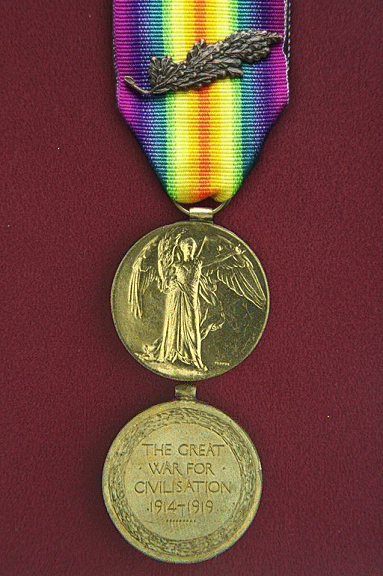
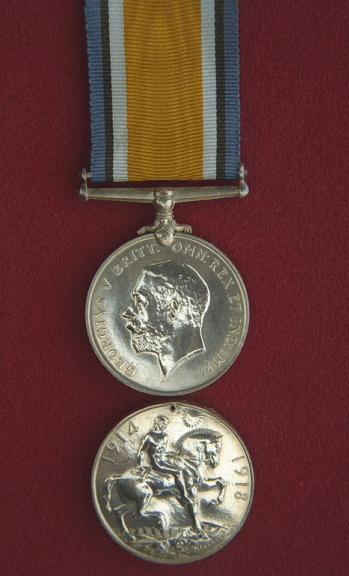
George Beeton

April 3rd,1893 - July 20th, 1973
Today George and Emma are together again
Montreal Memorial Park
Plot G. Section 245, Grave #3

George's lucky four leaf clover.
George, Grandpa said that after getting home from the war he was out
for a walk one day when
he noticed this four leaf clover growing out over the edge of the
sidewalk. He considered it to be
a sign of the good luck that helped him to make
it back home so he picked it and framed it.
| Dad
always said, "your Grandpa, Pop, is as
tough as nails." I had no true idea. |
Donald George Beeton August, 2021 |
|
|
Montreal Memorial Park
Plot G. Section 245, Grave #3
I called and confirmed that this is the correct cemetery. If you call and ask for Montreal Memorial Park they will transfer you to the Memorial Garden reception. The lady I spoke with was very helpful. After she confirmed that George and Emma were there I asked if she would be able to check for George's middle name but unfortunately after a search she could find no record of his middle name.
It appears as though the cemetery's name may have been changed a number of times over the years which as it turns out was the reason why I called to confirm our information.
Memorial Garden Funeral Complex Montreal, Urgel Bourgie/Athos
3955, Chemin Côte-de-Liesse
St-Laurent, Québec, H4N 2N6
1-844-735-2025
Map
Canadian Great War Project: Private George Beeton
Personnel Service Records Of The First World War: Search Result For Pte George Beeton
Pte George Beeton's (Regimental Documents) Service Records.pdf (1 of 77)
Enlistment, Health records, Pay records, Travel logs, Discharge, and other miscellaneous information etc. File Name: B0590-S047
Abbreviations used in Canadian First World War personnel records
Military Abbreviations used in Canadian Service Files
MANUAL OF ABBREVIATIONS (This is a very extensive detailed 610 page pdf )
DEPARTMENT OF NATIONAL DEFENCE AND THE CANADIAN ARMED FORCES
The 17th Duke of York's Royal Canadian Hussars, "Argenteuil Rangers,"
Royal Canadian Hussars, (Montreal)
Some History
Regimental History
Originally, Hussars were light cavalry mounted on fast horses.
By 1914 cavalry duties consisted largely of reconnaissance and protection.
Canadian Cavalry Trooper Sabre, 1908, Mark I
The Canadian version
wiki
The
24th
Battalion,
C.E.F., Victoria Rifles of Canada, 1914-1919
Unofficial War Diary of the 24th Canadian Battalion
The Victoria Rifles Of Canada, wiki
Plot G. Section 245, Grave #3
I called and confirmed that this is the correct cemetery. If you call and ask for Montreal Memorial Park they will transfer you to the Memorial Garden reception. The lady I spoke with was very helpful. After she confirmed that George and Emma were there I asked if she would be able to check for George's middle name but unfortunately after a search she could find no record of his middle name.
It appears as though the cemetery's name may have been changed a number of times over the years which as it turns out was the reason why I called to confirm our information.
Memorial Garden Funeral Complex Montreal, Urgel Bourgie/Athos
3955, Chemin Côte-de-Liesse
St-Laurent, Québec, H4N 2N6
1-844-735-2025
Map
Canadian Great War Project: Private George Beeton
Personnel Service Records Of The First World War: Search Result For Pte George Beeton
Pte George Beeton's (Regimental Documents) Service Records.pdf (1 of 77)
Enlistment, Health records, Pay records, Travel logs, Discharge, and other miscellaneous information etc. File Name: B0590-S047
Abbreviations used in Canadian First World War personnel records
Military Abbreviations used in Canadian Service Files
MANUAL OF ABBREVIATIONS (This is a very extensive detailed 610 page pdf )
DEPARTMENT OF NATIONAL DEFENCE AND THE CANADIAN ARMED FORCES
The 17th Duke of York's Royal Canadian Hussars, "Argenteuil Rangers,"
Royal Canadian Hussars, (Montreal)
Some History
Regimental History
Originally, Hussars were light cavalry mounted on fast horses.
By 1914 cavalry duties consisted largely of reconnaissance and protection.
A Commonwealth Pattern 1908 Mark I* Cavalry Troopers Sword and Mark I*
Scabbard manufactured in 1915. The sword is stamped
with British, Canadian and Commonwealth ownership marks as well as the
unit marks of the 17th Duke of York's Royal Canadian Hussars, 17.H.
The Canadian version
wiki
Unofficial War Diary of the 24th Canadian Battalion
The Victoria Rifles Of Canada, wiki
The Vics Patrol #1 The Vics Patrol #2
The active service journal of The Victoria Rifles Of Canada. A monthly newspaper.
24th Canadian Battalion Identification Patch
Also known as a Formation Patch or Battle Patch.

The blue and red colours. Worn on the shoulders.
The 2nd Canadian Division
The History Of The Second Canadian Division
The Order Of Battle Of The 2nd Canadian Division
The History Of The Second Canadian Division
The Order Of Battle Of The 2nd Canadian Division
Canadian Expeditionary Force - History
Canadian Expeditionary Force 1914 - 1919
An Official History of World War One
Canadian Expeditionary Force 1914 - 1919
An Official History of World War One
The
Battle Of Vimy Ridge. wiki
An aerial photograph of the battalion's battlefield at Vimy Ridge.
(156 of 256) Unofficial Diary Of The 24th
"The Battle of Amiens" YouTube lecture by Stuart Wheeler from the Tank Museum
The Battle Of Amiens
The 2nd Battle of Arras
Life in the trenches of the First World War
Joint or All-Arms Warfare on the Western Front, 1918
Great War Glossary
R.C.A.F. De Havilland Mosquito
The Miraculous Mosquito
I Rode A Mosquito
An interesting 1943 Maclean's article looking back at the Canadian production of the de Havilland Mosquito, and the author describes a flight he took in a Mosquito over Lake Ontario.
RMS Royal Majesty's Ship, S.S Laconia
I thought it would be interesting to include information about the standard issue service rifle that the 17th Duke of York's Royal Canadian Hussars, Argenteuil Rangers and the Canadian Corps used during the time period when Private George Beeton served with those units.
Magazine Lee Enfield MLE Mk1 - 1897
The Lee–Enfield rifle was introduced in November 1895 as the .303 calibre, Rifle, Magazine,
Lee–Enfield, or more commonly Magazine Lee–Enfield, or MLE (sometimes spoken as "emily" instead of M, L, E).
Cartridge: .303 British
It appears that the Lee Enfield MLE Mk1 was in service with Canadian units until 1905. Some of these rifles might have still been in the Hussar's inventory possibly used for training purposes during George's service with the unit but this is only a guess. The Lee Enfield MLE and the Ross Mark II service rifle that replaced it both used the .303 British rifle cartridge
During the time George Beeton served with the 17th Duke of York's Royal Canadian Hussars, Argenteuil Rangers, the unit had been issued the Ross Mark II infantry rifle produced by the Ross Rifle Company of Quebec. As indicated above by Canadian Royal Hussars Association member Mr. J. Cochrane, "By 1913, the unit probably had Ross Mark II."
The story of the Ross rifle is very complicated. In 1911 the Canadian army started to replace the Mark II with the improved Mark III Ross rifle. Mark III Ross rifle.
The Ross rifle is a straight-pull bolt action .303 inch-calibre rifle that was produced in Canada from 1903 until 1918. The Ross Mk.II (or "model 1905") rifle was highly successful in target shooting before World War I, but the close chamber tolerances, lack of primary extraction and overall length made the Mk.III (or "1910") Ross rifle unsuitable for the conditions of trench warfare, exacerbated by the often poor quality ammunition issued.
By 1916, the Ross rifle had been withdrawn from Canadian front line service and was replaced by the Lee Enfield SMLE MkIII* British service rifle. The Ross Mark III rifle continued to be used by many snipers of the Canadian Expeditionary Force until the end of the war due to its exceptional accuracy and it's advanced and easy to use sight system. In some instances higher quality ammunition was issued to snipers using the Ross rifle. The higher quality ammunition usually eliminated extraction problems caused by the Ross rifle's tight chamber tolerances and also provided more consistent ballistics.
SMLE Mk III*
The Short Magazine Lee-Enfield, (SMLE) Mk III* is a bolt-action, magazine-fed repeating rifle that served as the main firearm used by the military forces of the British Empire, Canada and the Commonwealth during WW1. In late 1915 the SMLE Mk III* (star*) was introduced incorporating several changes to the SMLE Mk III that preceded it. In 1926 the designation name of the rifle was changed to the Lee-Enfield SMLE No. 1 Mk III*
Cartridge: .303 British
A very good video from the TV series; For King and Empire
Episode 3, Storming the Ridge, Vimy Ridge, 1917.
Hosted by Canadian Military Historian Norm Christie.
47:27
Timeline
- World History Documentaries. TV documentary Series
The Canadian Victory Over The Germans That Shaped The Great War | Battle of Vimy Ridge
Timeline Recreates for the viewer one of the greatest battles in Canadian military history.
1:34:20
This video goes into great depth and provides a lot of very interesting details.
The Canadian Victory Over The Germans That Shaped The Great War | Battle of Vimy Ridge
Timeline Recreates for the viewer one of the greatest battles in Canadian military history.
1:34:20
This video goes into great depth and provides a lot of very interesting details.
I would like to thank the owners of the images I include on this personal family page. dbeeton at cogeco.ca |